
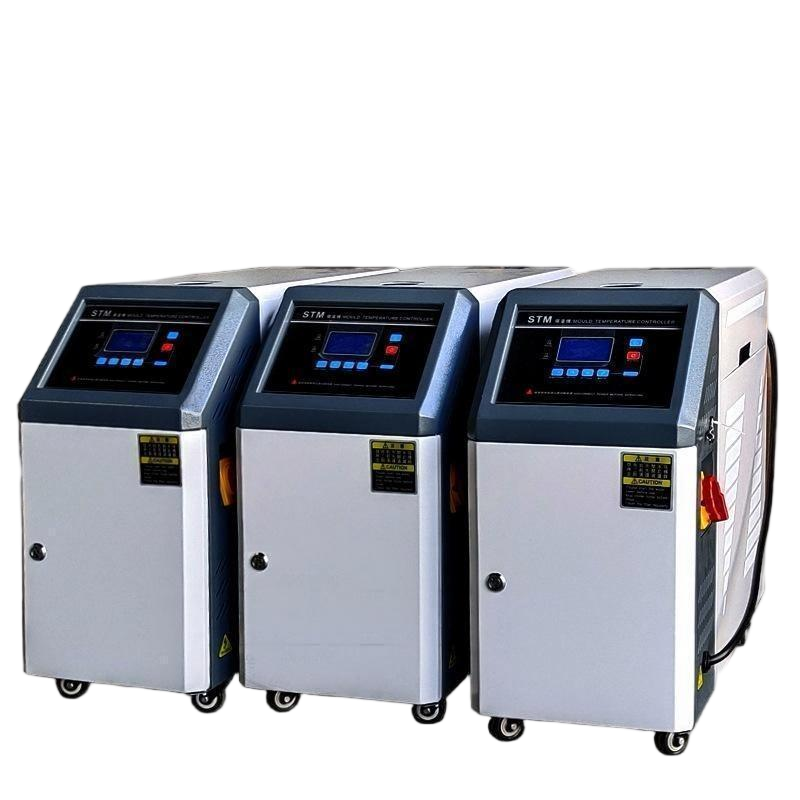
Oil Mold Temperature Controller
Our oil mold temperature controller is designed for high-temperature applications up to 300°C, widely used in injection molding, die casting, rubber processing, and composite molding. It features precise PID temperature control, fast heating, stable oil circulation, and reliable safety protection, helping improve product quality, reduce cycle time, and increase production efficiency.
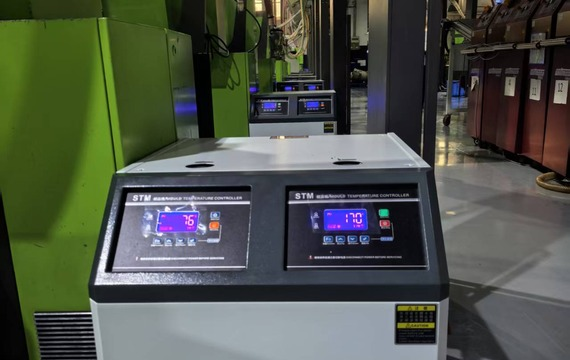
Yushine – Professional Oil Mold Temperature Controller Manufacturer
- 20+ years of manufacturing experience
- Annual production capacity of over 8,500 units
- Fast delivery with standard models available from stock
- Experienced technical team with 20+ engineers
- OEM & customized solutions available
- Rich experience in injection molding and industrial temperature control
- Professional technical support and after-sales service
Oil Mold Temperature Controller Series
Yushine oil mold temperature controllers are designed for precise and stable high-temperature control up to 300°C. Our product range includes standard models and dual-zone dual-temperature models, with various heating capacities, pump sizes, and customized configurations to meet different industrial requirements. Customized solutions are also available.
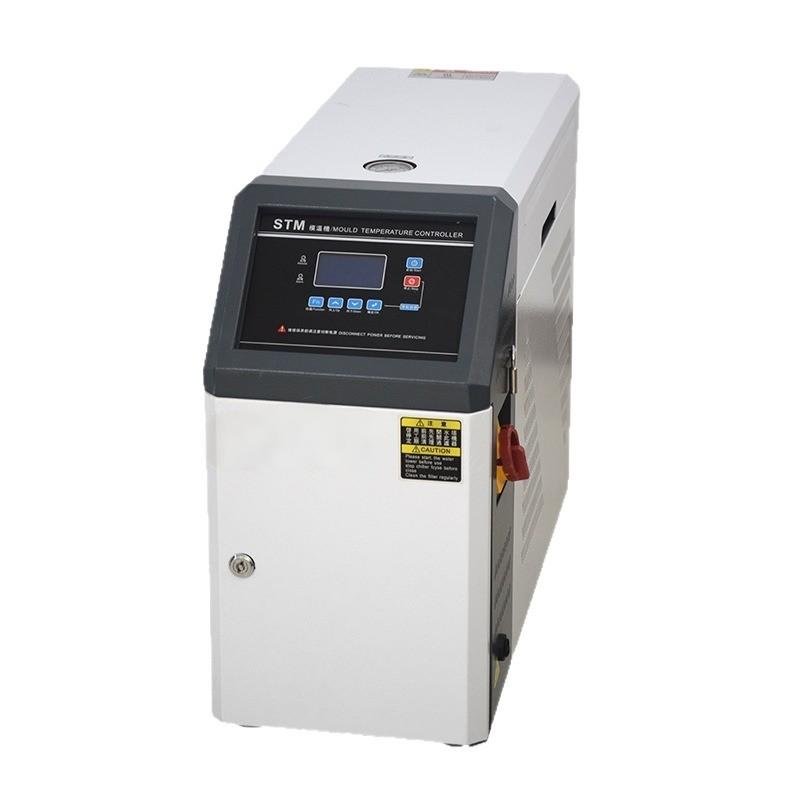
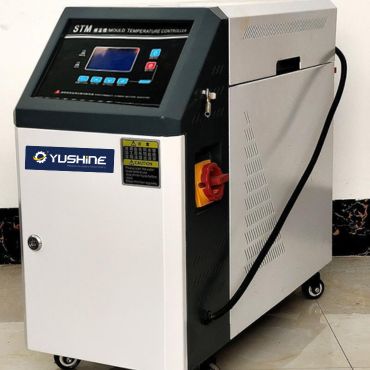
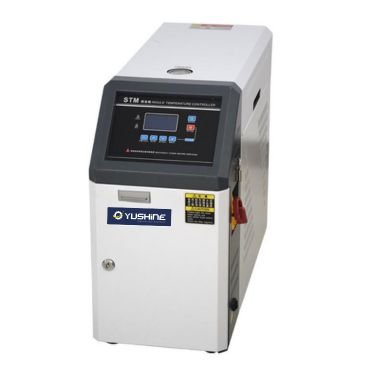
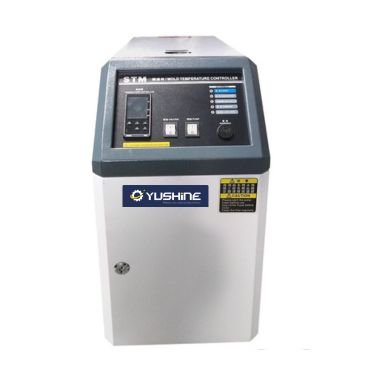
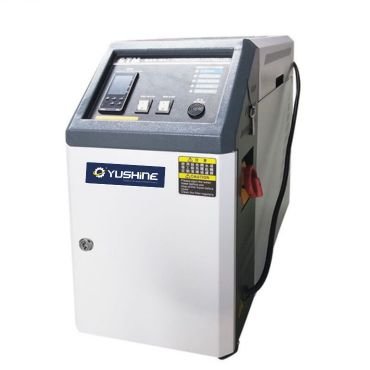
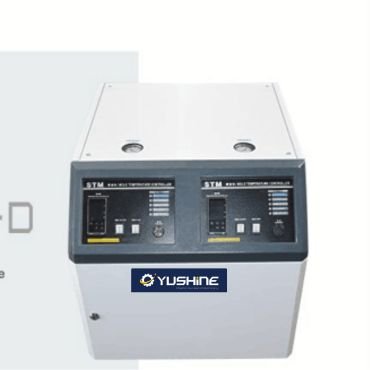
Specification
| Model | Max. Temp. | Heating Power (kW) | Pump Power (kW) | Pump Flow (L/min) | Pump Pressure (bar) | Heating Tank Capacity (L) | Main Tank / Expansion Tank (L) | Cooling Method | Mold Connector (inch) | Dimensions H×W×D (mm) | Weight (kg) |
| STM-600-O | 200°C | 6 | 0.5 | 27 | 3.8 | 1 | 6 / 3.2 | Indirect Cooling | 3/8″ (2×2) | 635×280×740 | 60 |
| STM-900-O | 200°C | 9 | 0.75 | 42 | 5 | 1 | 6 / 3.2 | Indirect Cooling | 3/8″ (2×2) | 655×280×740 | 72 |
| STM-1200-O | 200°C | 12 | 1.5 | 74 | 6.2 | 2 | 6.8 / 11.8 | Indirect Cooling | 3/8″ (4×2) | 695×340×815 | 105 |
| STM-2400-O | 200°C | 24 | 2.8 | 130 | 8 | 2 | 11/16 | Indirect Cooling | 1″ (1.2) | 870×360×930 | 140 |
| STM-3600-O | 200°C | 36 | 4 | 200 | 8 | 4 | 14 / 16 | Indirect Cooling | 1″ (1.2) | 980×415×930 | 165 |
| STM-900HT | 300°C | 9 | 0.75 | 42 | 5 | 1 | 6/6 | Indirect Cooling | 3/4″ | 655×280×740 | 72 |
| STM-1200HT | 300°C | 12 | 1.5 | 74 | 6.2 | 2 | 6.8 / 16 | Indirect Cooling | 3/1″ | 695×340×815 | 13* |
| STM-2400HT | 300°C | 24 | 2.8 | 130 | 8 | 2 | 16 / 25 | Indirect Cooling | 1/1″ | 870×360×930 | 190 |
REQUEST A QUOTE FOR MORE DETAILS
All You Need to Know About Oil Mold Temperature Controllers
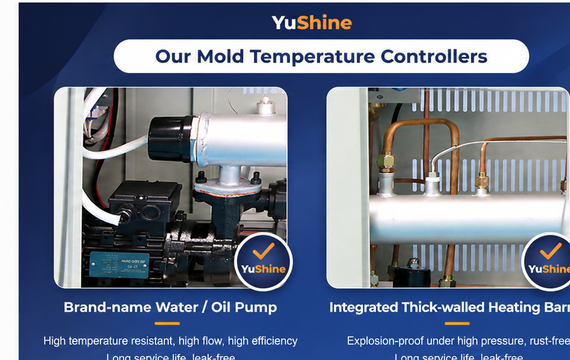
Oil mold temperature controllers are widely used in plastic injection molding, die casting, rubber forming, composite molding and chemical reaction processes, wherever the mold or equipment must be held at a high, stable temperature.
Thermal oil is the heat transfer medium. A circulation pump sends the heated oil from the built-in oil tank through the mold and back. The heater switches on below the set value and off once it is reached. Standard models work up to 200°C and high-temperature models up to 300°C. The return oil is cooled indirectly by a plate heat exchanger, so the oil and cooling water never mix.
Digital PID control holds the temperature within ±1°C. Protection includes phase loss and reverse phase, oil shortage, over-temperature, pump overload and heater failure alarms, and a fault code table on the panel shows the cause. The integrated 304 stainless steel piping reduces flow resistance and scale build-up. For maintenance, regularly check the oil level and connections, and change the thermal oil every 6 to 12 months.
Why Choose an Oil Mold Temperature Controller?
Oil controllers reach a higher temperature than water controllers at the same power: up to 200°C for standard models and up to 300°C for high-temperature models. Thermal oil conducts heat well, heats quickly, and holds a precise constant temperature with small fluctuations, which keeps product quality stable in high-temperature molding. Because the oil is cooled indirectly through a plate heat exchanger, the oil never mixes with cooling water. The trade-off is that thermal oil must be checked and replaced every 6 to 12 months, and the water controller is the better choice when the process stays below about 180°C.
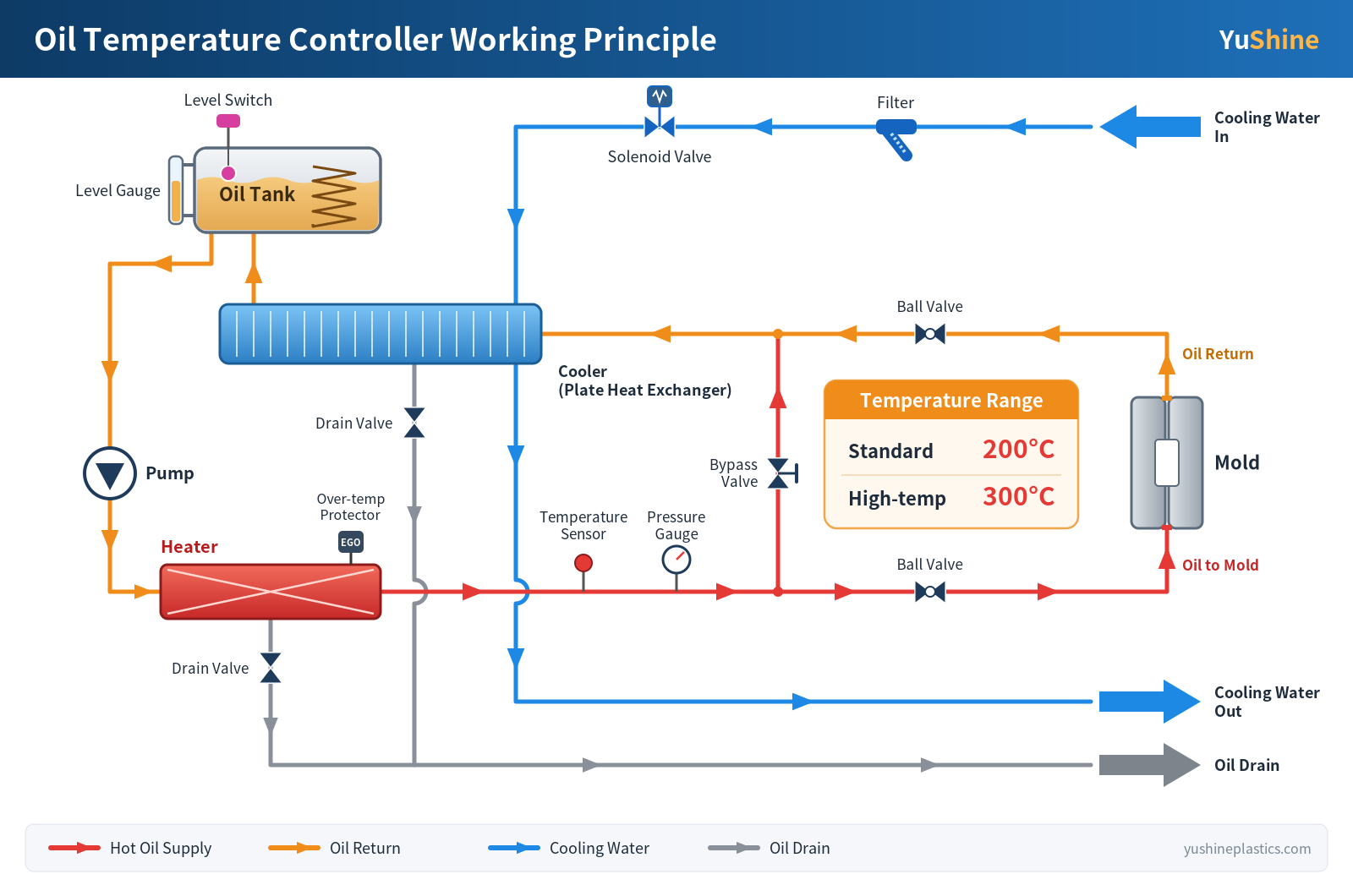
Oil Mold Temperature Controller Key Features
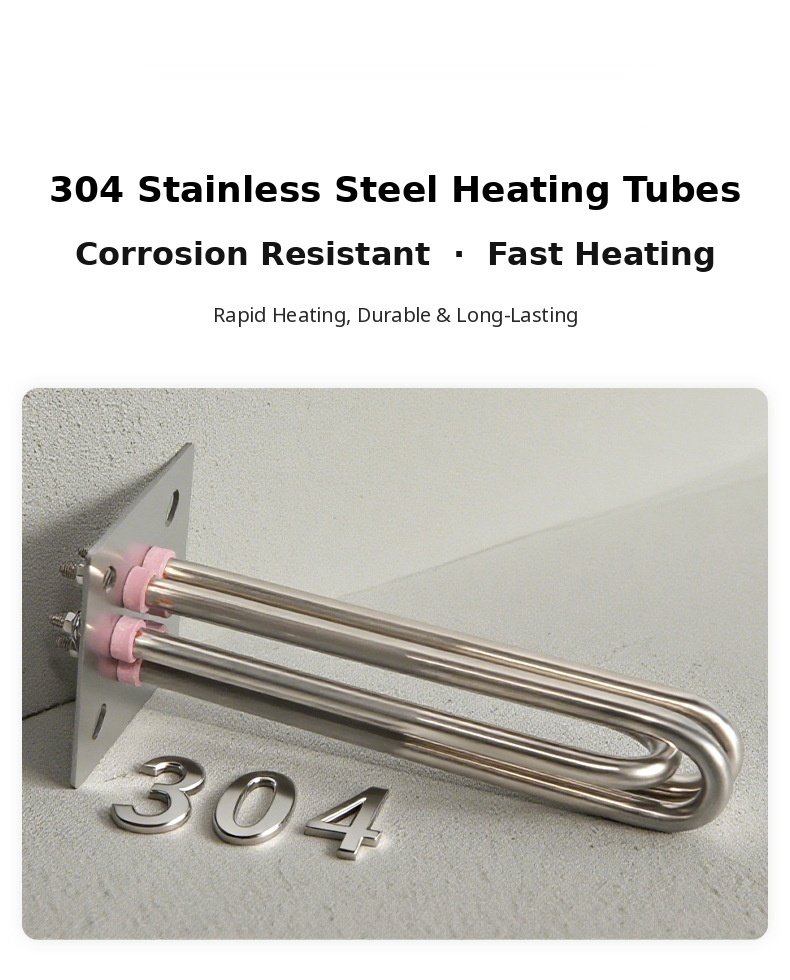
304 seamless stainless steel heating tubes for high pressure and corrosion resistance
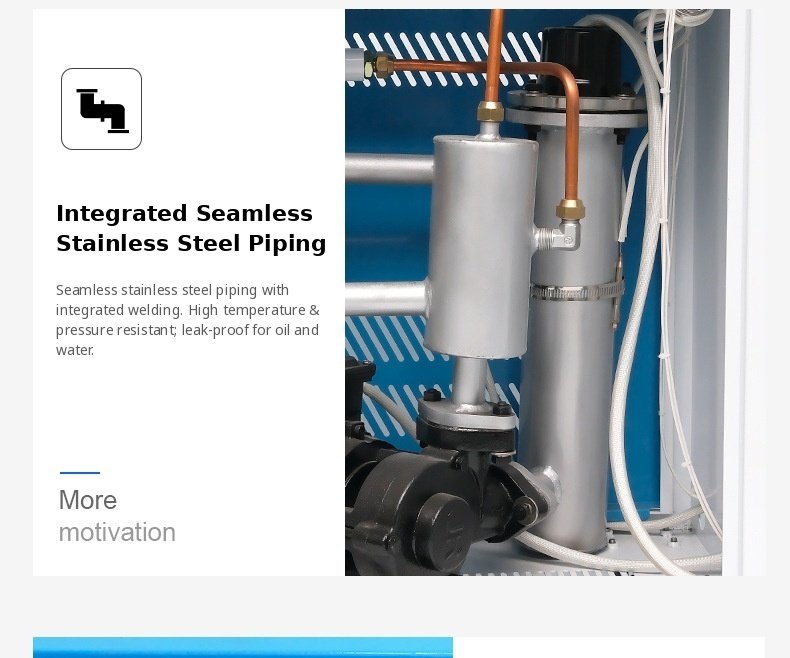
Integrated 304 stainless steel piping to reduce flow resistance and scale buildup
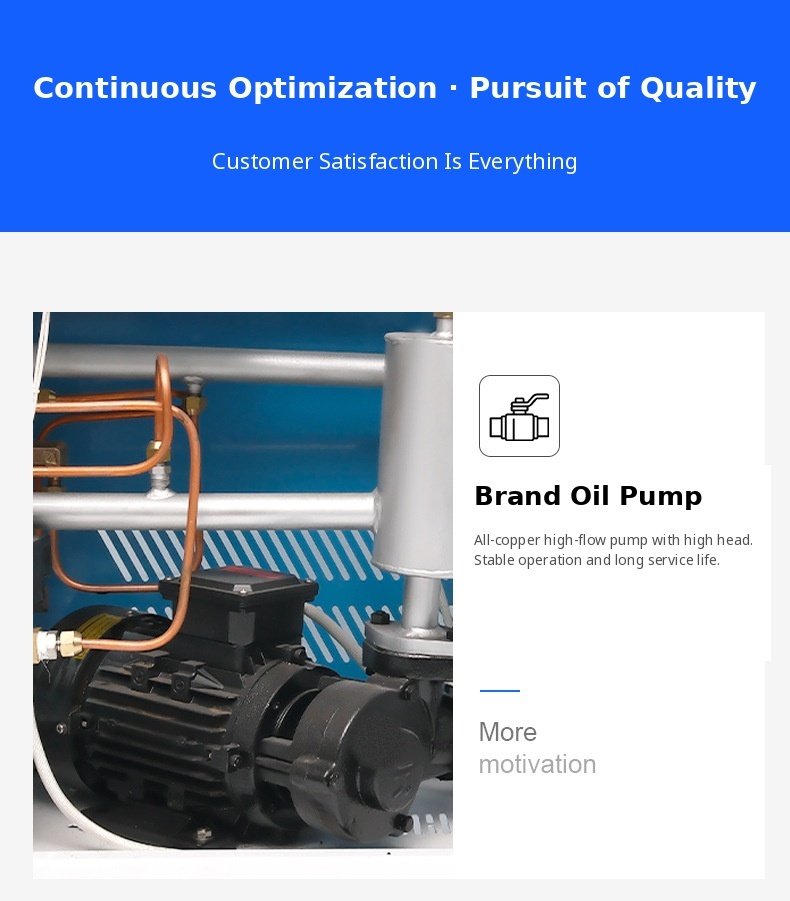
All-copper high-temperature oil pump; low noise, with automatic air venting at startup
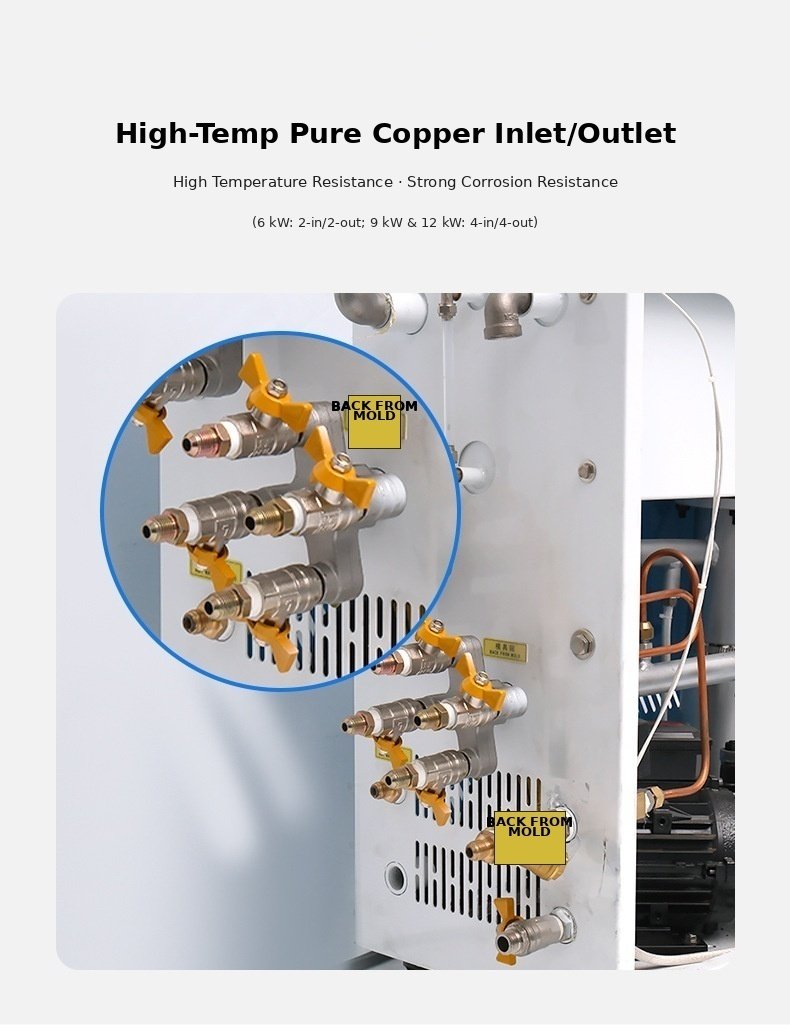
High-temperature pure copper manifolds — 2-in/2-out for 6 kW; 4-in/4-out for 9–18 kW
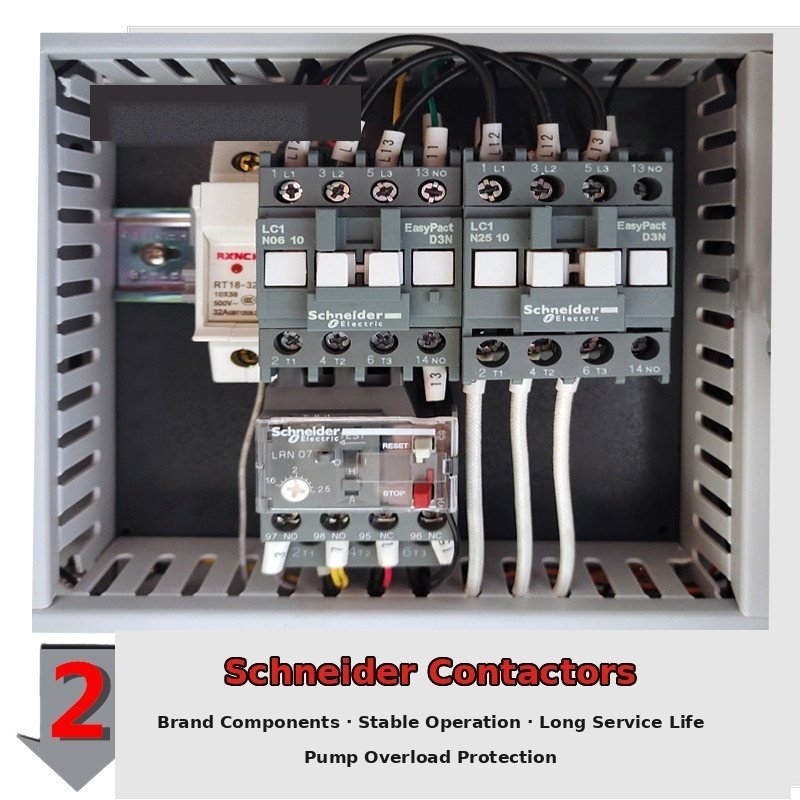
Isolated control cabinet with solid-state relays and branded contactors
Taiwan-made control panel for stable and reliable operation

Oil Mold Temperature Controller Applications
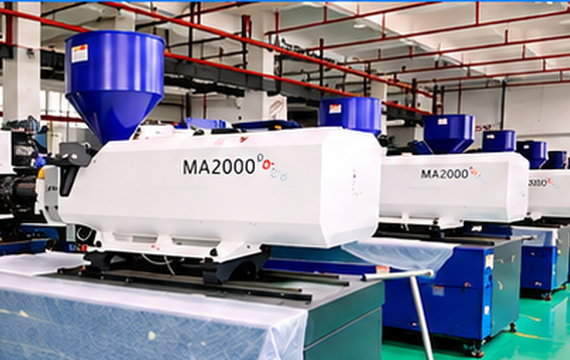
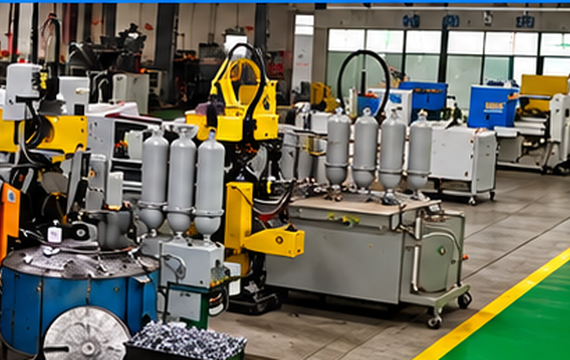
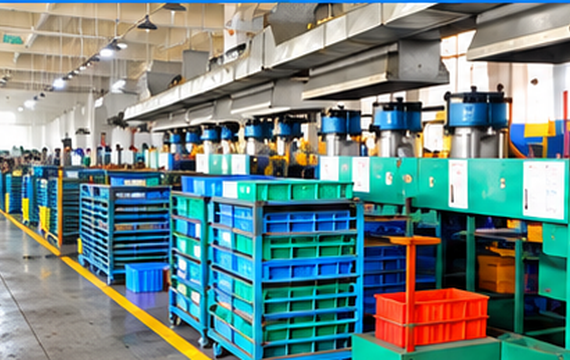
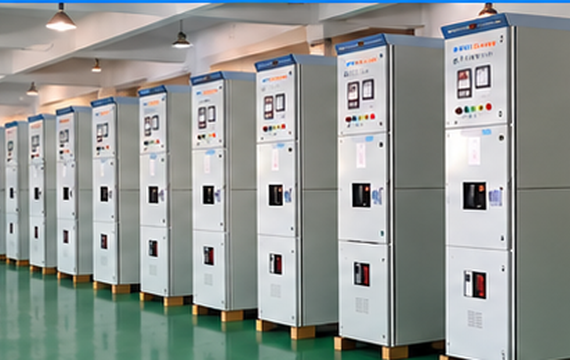
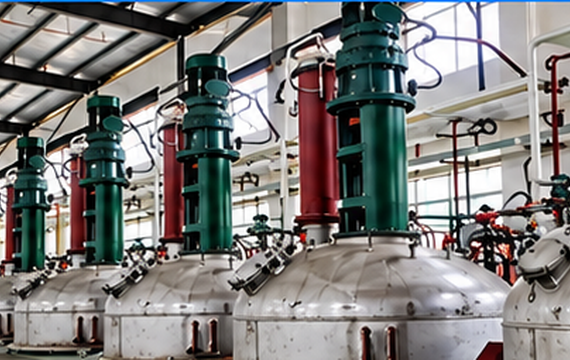
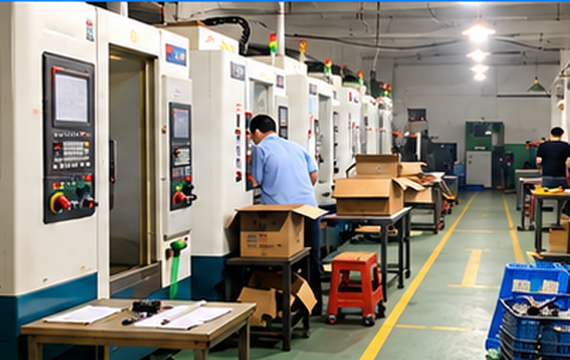
Oil mold temperature controllers heat and hold a mold or process equipment at a constant temperature, up to 200°C for standard models and up to 300°C for high-temperature models.
Protection Functions
How to Choose an Oil Mold Temperature Controller
Choose the right temperature, heating power and pump capacity for your molding process.
Our oil temperature controllers are available in standard models up to 200°C and high-temperature models up to 300°C.
Up to 200°C / 300°C
Choose a standard model (up to 200°C) for most molds, or a high-temperature model (up to 300°C) when the process needs more. Both use indirect cooling.
6 to 36 kW (6 / 9 / 12 / 18 / 24 / 36 kW). Do not choose by the tonnage of the injection machine alone, because it is too rough and can waste power or leave the mold under-heated. Use one of the two methods below.
View heating power formulas
Quick workshop formula: Heating power (kW) ≈ mold weight (kg) × coefficient (0.018 to 0.025).
- Use 0.018 for general products, PP/ABS, and mold temperature below 80°C.
- Use 0.022 to 0.025 for transparent parts, PC, glass fiber materials, mold temperature above 90°C, and thin-wall high-speed production.
- Example: a 350 kg mold, PC material, 100°C mold temperature. Use 0.022: 350 × 0.022 = 7.7 kW, so select the next standard size, 9 kW.
Precise formula (to check high-power models and special mold conditions): KW = (W × ΔT × 0.11 × S) / (860 × T)
- W: mold weight (kg)
- ΔT: target mold temperature minus ambient temperature (°C)
- 0.11: specific heat of steel (kcal/kg·°C)
- S: safety factor, usually 1.3 to 1.5
- T: time to reach the target temperature (hours), generally 0.5 to 0.75
- 860: conversion constant between kW and kcal
- Example: a 200 kg steel mold heated from 20°C to 150°C in 0.5 hour with S = 1.4: (200 × 130 × 0.11 × 1.4) / (860 × 0.5) ≈ 9.3 kW, so select 12 kW.
If the mold weight is unknown: measure the mold length, width and height, then estimate the weight from the volume using a mold steel density of about 7.85 tons per cubic meter.
Insulation plates: the higher the mold temperature, the faster it loses heat. Insulation plates between the mold and the machine platen reduce heat loss and improve heating efficiency.
Pump power 0.37 to 4.0 kW, flow 27 to 200 L/min, pressure 3.8 to 8.0 bar. Match the flow to the number of mold circuits.
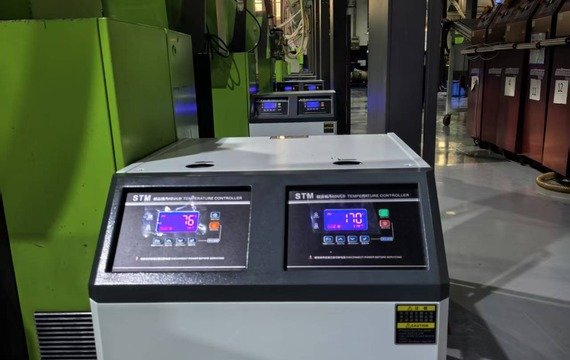
Calculate heating power using the formulas above.
Check flow and pressure
6 kW: 2-in 2-out; 9–18 kW: 4-in 4-out. Dual-zone models control two temperatures separately.
Meet your cycle needs. PID control holds ±1°C.
Stable PID control within ±1°C.
Air-blowing oil return, instant cooling shutdown, multi-point temperature control, RS485, non-standard voltage and protection functions can be customized.
Frequently Asked Questions
Every six months to a year, depending on working temperature and how often the machine runs. If it often works near 200°C, change it about once a year to prevent the oil from carbonizing and losing heat transfer performance. If the machine runs at high temperature but rarely, the change can be delayed. If the oil degrades or water mixes in, change it at once.
Before starting, check that the expansion tank oil level is above 1/2 to 3/5, the level sensor works and the voltage and display are normal. Start the circulation pump and let it run for about 0.5 hour until the pressure is stable, then start heating. To stop, lower the set temperature, stop heating, wait until the oil is below 70°C, stop the pump, then turn off the main power.
Turn off the heating tubes immediately and let the oil cool naturally.
At the same power, oil reaches a higher temperature, conducts heat well, heats quickly and holds a precise constant temperature. Standard oil models reach 200°C and high-temperature models 300°C.
No. The oil is cooled indirectly through a plate heat exchanger, so the oil and the cooling water never mix. The cooling water connects to the cooling water inlet and outlet on the machine.
The machine alarms for phase loss, oil shortage, over-temperature and overload. The fault code table below the panel tells you the cause.
Case Models
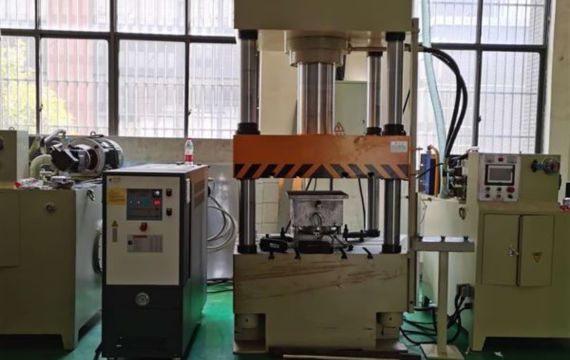
Mold temperature controller, using PLC control and heat transfer oil circulation mold temperature controller, could control the mold temperature and pressure precisely according to the product molding process; it could heat the mold temperature to above 280℃ quickly and then cool it down to below 80 ℃in a short time so that the production cycle is shortened, and same batch product quality guaranteed. Meanwhile, the mold temperature controller could also control holding time according to the product’s requirements.
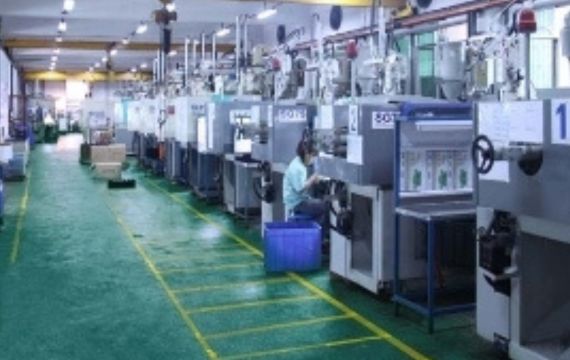
The headlight lens is made of PC material. Mold temperature controllers precisely control the temperature of the mold cores and plates, ensuring a smooth surface, high weld line strength, and reduced internal stress, optimizing the molding process. In practical applications, the mold temperature is controlled within the 80-140℃ range.
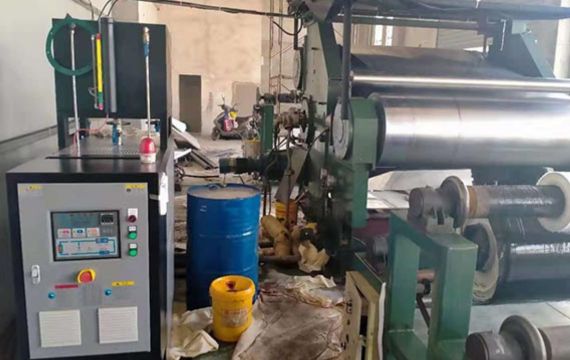
The rubber extruder is critical equipment in the rubber processing industry.It is used to extrude rubber materials into required shapes, and the rubber extruder mold temperature controller is an essential auxiliary device for the rubber extruder. It ensures the rubber extruder works correctly by controlling the temperature precisely to keep the rubber material in good condition during the extrusion process.
