
What Is a Self-Contained Hopper Loader? Working Principle & Selection Guide
Manual loading still slows many injection molding and extrusion lines. Bags are opened by hand, material is poured into hoppers, dust spreads across the workshop, and operators spend hours on a task that should be automatic.
A self-contained hopper loader solves this with a compact vacuum conveying unit: blower, filter, receiver, and controls in one machine. It moves plastic pellets from bags, bins, or silos to the processing machine with less labor, cleaner handling, and more stable feeding.
This guide explains what a self-contained hopper loader is, how it works, where it fits, how it compares with a separate vacuum loader, and how to choose the right model for your plant.
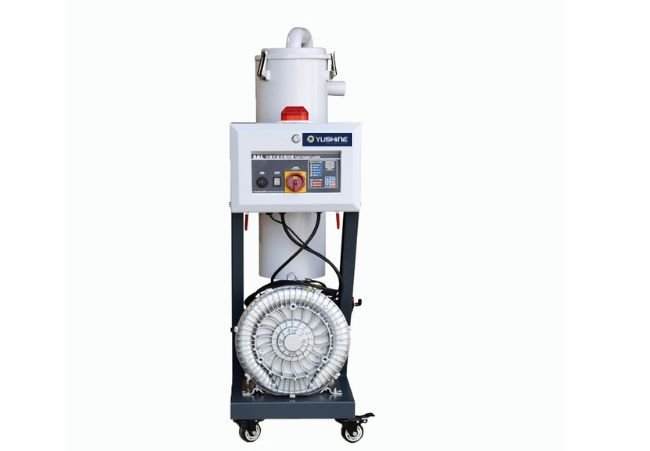
What Is a Self-Contained Hopper Loader?
A self-contained hopper loader (also called an integral vacuum loader or auto-loader) is a material conveying system that combines the vacuum source and the material receiver in a single unit. It is typically mounted directly on the injection molding machine hopper, dryer inlet, or extruder feed throat.
Unlike a separate vacuum system—where a floor-standing blower serves one or more remote receivers—the self-contained design keeps everything together. That makes installation simple, footprint small, and operation straightforward for single-machine feeding.
It is mainly used to convey free-flowing plastic pellets, granules, and light regrind over short to medium distances.
How Does a Self-Contained Hopper Loader Work?
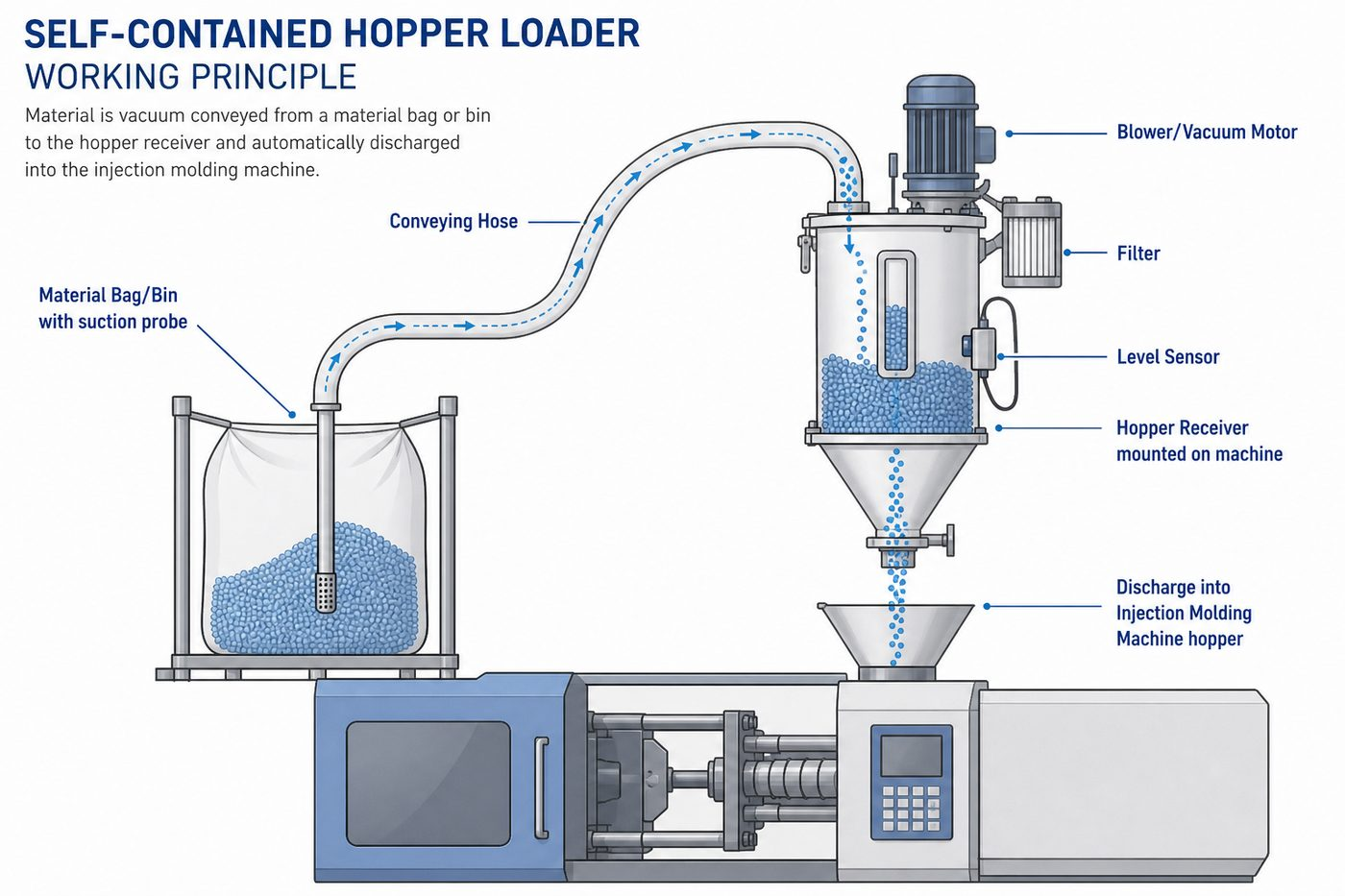
The working cyhttps://yushineplastics.com/self-contained-hopper-loaders/cle is based on vacuum conveying:
- Vacuum generation — A motor-driven blower creates negative pressure inside the hopper receiver.
- Material pickup — The suction wand or probe is placed in a material bag, storage bin, or silo. Pellets are drawn into the conveying hose with the airflow.
- Separation — Material enters the receiver and settles. Air is separated from pellets and routed through a filter.
- Filtration — Dust and fines are captured so clean air can be exhausted and the blower stays protected.
- Discharge — When the level sensor signals that the hopper is full—or the timed loading cycle ends—the vacuum stops and material discharges into the machine hopper by gravity.
- Repeat — The next cycle starts automatically when the material level drops.
Main Components of a Self-Contained Hopper Loader
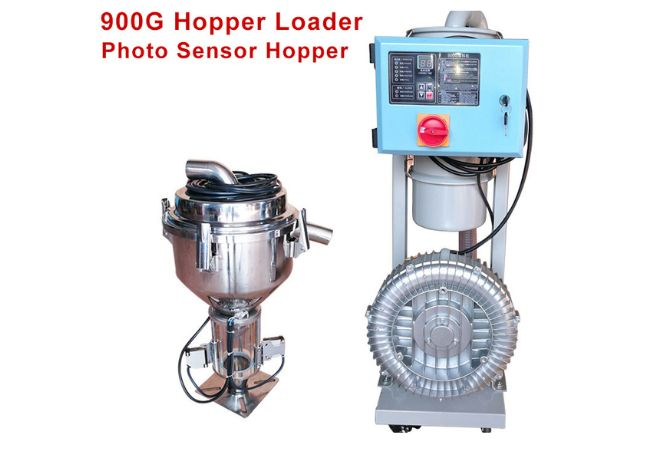
A typical self-contained hopper loader includes:
• Hopper / receiver — Stainless steel chamber that collects conveyed material and discharges it into the machine.
• Blower / vacuum motor — Provides suction power for conveying. Motor size largely determines capacity and conveying distance.
• Filter system — Separates dust from exhaust air; many designs support reverse-air or automatic dust cleaning.
• Suction probe and hose — Pickup tool and conveying line from the material source to the receiver.
• Level sensor — Detects high/low material level and triggers the loading cycle.
• Control panel — Sets cycle parameters, displays status, and triggers alarms for overload or lack of material.
• Base / mounting flange — Secures the unit on the machine hopper or dryer.
Optional upgrades often include LCD touchscreen control, proportioning valves for virgin/regrind mixing, and higher-grade electrical components for continuous duty
Where Are Self-Contained Hopper Loaders Used?
Self-contained hopper loaders are common wherever plastic resins need short-distance automatic
feeding:
• Injection molding — Feeding virgin pellets or regrind to the machine hopper
• Extrusion — Stable feeding for profiles, sheet, pipe, and film lines
• Blow molding — Consistent resin supply for bottle and container productionself-contained hopper loaders (300G/400G)
• Drying systems — Loading material into hopper dryers or dehumidifying dryers
• Small-to-medium workshops — Plants that need automation without a central multi-station vacuum system
Typical industries include automotive parts, packaging, home appliances, consumer goods, and medical plastics—anywhere material purity, labor cost, and uptime matter.
Advantages of Using a Self-Contained Hopper Loader
- Lower labor cost — Reduces manual bag handling and continuous hopper topping-up.
- Cleaner workshop — Enclosed conveying limits dust, spills, and open-bag contamination.
- More stable feeding — Automatic cycles keep material level consistent and reduce starve/overfill risk.
- Compact installation — One unit on the machine; no separate floor blower for simple applications.
- Faster changeover readiness — Easier to move or reassign than a full central conveying system.
- Better safety — Less manual lifting of heavy resin bags and fewer trip hazards from open containers.
Self-Contained Hopper Loader vs Separate Vacuum Hopper Loader
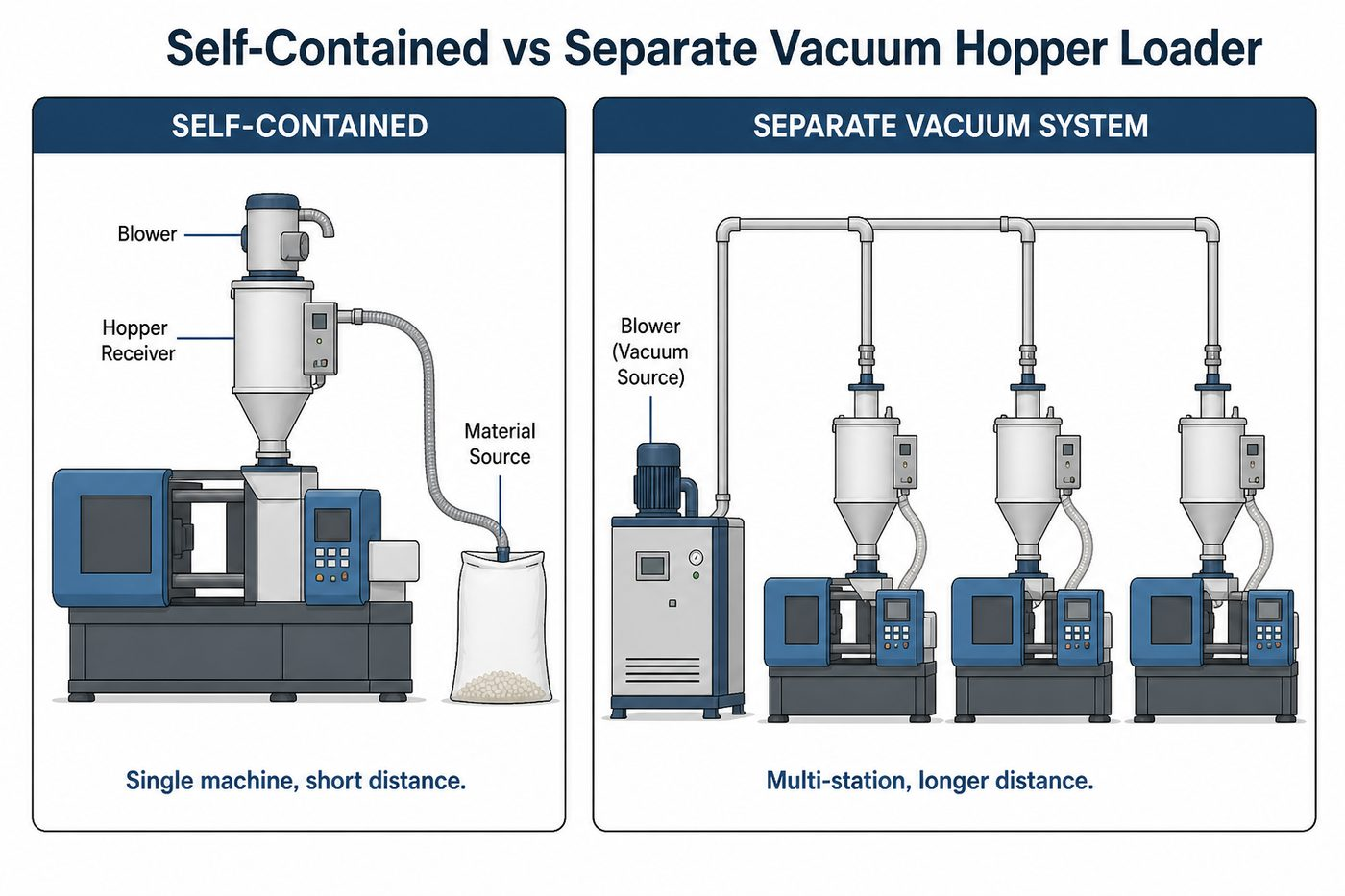
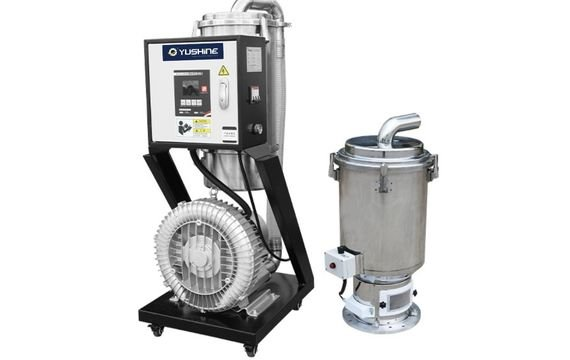
| Point | Self-Contained Hopper Loader | Separate Vacuum Hopper Loader |
| Structure | Blower + receiver in one unit | Floor blower + remote receiver(s) |
| Best for | Single machine, short distance | Long distance, multi-station feeding |
| Installation | Simple, machine-mounted | Needs floor space and piping layout |
| Conveying power | Moderate | Higher; suited to longer runs |
| Flexibility | Easy to relocate per machine | Better for centralized automation |
| Investment | Lower entry cost | Higher, scales with stations |
Yushine supplies both types, so selection can follow your layout rather than forcing one architecture.
How to Choose the Right Hopper Loader
- Material type — Pellet, regrind, powder, or mixed? Powder and dusty regrind need stronger filtration and may require a different conveying approach.
- Throughput (kg/h) — Match conveying capacity to your machine’s material consumption with a safety margin.
- Conveying distance and height — Longer horizontal runs and vertical lifts need more vacuum power and suitable hose diameter.
- Machine interface — Confirm mounting flange, hopper size, and whether the loader feeds a dryer or the machine directly.
- Duty cycle — Continuous production favors robust motors, reliable filters, and quality electrical parts.
- Control needs — Basic timed control is enough for many lines; touchscreen, proportioning, and networked alarms help in higher-spec plants.
- Cleaning and changeover — If you change resins often, prioritize easy filter access and stainless contact parts.
- Future expansion — If you may add machines later, evaluate whether starting with a separate multi-station system is more economical long term.
If you share resin type, hourly consumption, conveying distance, and machine model, Yushine can recommend a matching loader configuration.
Contact Yushine Today
A correctly sized self-contained hopper loader reduces labor, keeps material cleaner, and stabilizes feeding on injection molding and extrusion lines. Yushine manufactures plastic auxiliary equipment—including self-contained and separate vacuum hopper loaders—backed by application support and factory testing before shipment. Tell us your material, conveying distance, and target capacity. We will help you select the right hopper loader for your workshop.
