What is the Difference Between Air Cooled Scroll chiller and Air Cooled Screw Chiller
October 25, 2025
In modern plastic molding, pharmaceutical manufacturing, electronics production, and central air-conditioning systems, the chiller is a core refrigeration unit that stabilizes operating temperatures, ensures product quality, and maintains production efficiency.
Based on compressor type, air-cooled chillers are divided into two categories: scroll and screw. Although both use air cooling for heat dissipation, they differ significantly in structural design, performance characteristics, and application scenarios.
The basic structure of a screw compressor is shown in the figure below. Inside the compressor casing, a pair of intermeshing helical rotors is arranged in parallel. The rotor with the thicker tooth profile is usually called the male rotor (or male screw), while the one with the thinner tooth profile is called the female rotor (or female screw). In general, the male rotor is coupled to the prime mover and drives the female rotor.
A ball bearing at the discharge end of the rotors provides axial positioning and bears the axial forces within the compressor. Openings of specific shapes and sizes are provided at both ends of the compressor casing: one serves as the suction port (inlet) and the other as the discharge port (outlet). Typically, air enters from the top and is discharged from the bottom.
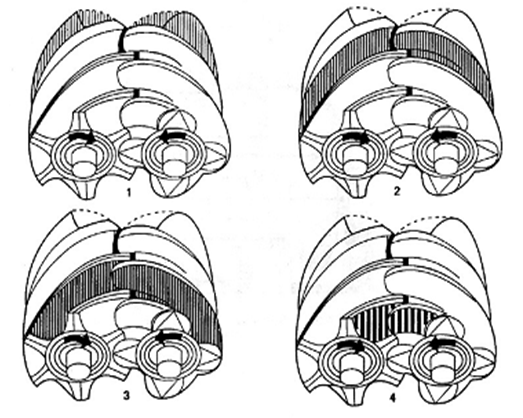
As shown in the figure below, the working cycle of a screw compressor can be divided into three stages: suction (1), compression (2)(3), and discharge (4). As the rotors rotate, each pair of intermeshing lobes successively completes the same working cycle. The gas sealed in the inter-lobe cavities moves with the rotors, and the enclosed volume gradually decreases, causing the pressure to rise and thereby compressing the gas. When the inter-lobe cavity connects with the discharge port, the discharge process begins.
The basic structure of a scroll compressor consists of two identically shaped, intermeshing scroll plates — one fixed, called the stationary scroll, and the other performing a small eccentric orbital motion around the stationary scroll’s center, known as the orbiting scroll. When the two scrolls engage, several crescent-shaped compression chambers are formed between them. As the orbiting scroll moves, these outer chambers gradually shift toward the center, continuously drawing in, compressing, and discharging the gas, achieving a smooth and continuous compression process. The operating principle of the scroll compressor can be divided into three stages: suction, compression, and discharge.
When the orbiting scroll begins to move, the suction port at the outer edge opens, allowing gas to enter the outer crescent-shaped chamber. As the orbiting motion continues, the gas is gradually sealed and pushed toward the center, with the volume decreasing and pressure increasing. Once the compressed gas reaches the central area and connects with the discharge port, the high-pressure gas is expelled, completing one full compression cycle.
Performance Comparison
Although both screw compressors and scroll compressors are positive displacement types, their different designs result in significant differences in performance, efficiency, noise, and application areas.
1. Energy Efficiency and Operating Characteristics
Screw Compressor: The compression process is continuous and stable, offering high volumetric efficiency and excellent performance for long-term, full-load operation. Energy output can be adjusted continuously via a slide valve or an inverter, maintaining high efficiency even at partial load.
Scroll Compressor: With a smaller compression chamber, it is suitable for medium and small-capacity refrigeration systems. Its frequent start-stop operation and capacity adjustment usually rely on multiple units running in combination. The overall efficiency is slightly lower than that of screw compressors, but scroll systems perform more flexibly under light or intermittent loads.
2. Noise and Vibration
Scroll Compressor: With no suction/discharge valves or reciprocating motion, it operates quietly with minimal vibration — ideal for noise-sensitive environments such as laboratories, electronics production lines, and medical refrigeration systems.
Screw Compressor: Due to intermeshing rotors, it produces low-frequency noise during operation. However, with proper sound insulation, noise can be effectively reduced. Its operational stability is superior to that of traditional piston compressors.
3. Maintenance and Reliability
Scroll Compressor: Compact structure, fewer components, low mechanical wear, and easy maintenance result in low operating costs and high reliability — suitable for applications requiring minimal maintenance and high uptime.
Screw Compressor: Although more complex in structure, its components are durable and long-lasting, allowing continuous operation throughout the year. Regular replacement of lubricating oil and filter elements ensures long-term, efficient, and stable performance.
Application Comparison
Item
Scroll Type Chiller
Screw Type Chiller
Typical Cooling Capacity
3HP–60HP
60HP–600HP and above
Application Fields
Small injection molding machines, laboratory equipment, electronic cooling
Medium to large factories, centralized cooling systems
Noise Level
Low (about 55–60 dB)
Moderate (about 65–75 dB)
Energy Efficiency
Better under light load
Higher efficiency at full load
Control Method
On/off or multiple-unit parallel operation
Stepless adjustment via slide valve or inverter
Maintenance Cost
Low
Medium to high
Investment Budget
Lower
Higher
Selection Recommendations
When selecting an air-cooled chiller, it is important to consider factors such as production scale, operating hours, energy efficiency requirements, and budget:
For single injection molding machines or small to medium-sized factories, a scroll type chiller offers an economical and efficient choice.
For large production lines, central air-conditioning systems, or centralized cooling projects, a screw type chiller is more suitable.
For applications that require maximum energy savings, an inverter screw chiller can be selected. It automatically adjusts power output according to load demand, achieving higher overall efficiency.
Yushine, as a professional manufacturer of auxiliary equipment for plastic molding, provides complete temperature control solutions — from scroll type chillers and screw type chillers to mold temperature controllers, cooling towers, and central water supply systems. We design high-efficiency, energy-saving cooling systems for global clients such as WIK, Philips, DeLonghi, and Nestlé, helping them achieve stable production, energy optimization, and intelligent management.