
In the plastic products processing industry, selecting a suitable plastic dryer is essential for production efficiency, product quality, and energy savings. Yushine provides the following different types of dryers:
Hot Air Dryers.

They are the most common plastic dryer types, with a single-layer barrel design, relatively simple structure, easy operation, and low cost. They achieve the drying of plastics by heating air to remove moisture.
European-Style Dryers.
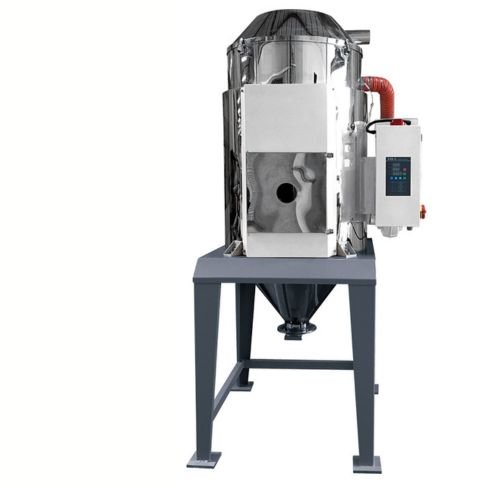
They are priced higher than standard models but have a better drying effect, mainly due to the design of blowing air from below, which makes the hot air evenly diffuse to keep plastic granules dry. They are stabler in operation, with a stainless steel barrel and insulation cotton inside the insulation layer, whose insulation effect is several times that of hot air dryers, so it is more energy-saving. The microcomputer control board’s temperature precision is ±0.1 degrees, with a 24-hour timer and over-temperature alarm feature. Because of the excellent insulation effect, the barrel temperature won’t increase the workshop temperature, so the energy consumption of European-style dryers is 30% to 40% lower than that of traditional dryers, thus a better choice for materials like PET and nylon that need high-temperature baking.
Dehumidifying Dryers.

It is mainly suitable for plastics with high water absorption and strict moisture content requirements (below 800 ppm)—principles of hot air dryers and a dehumidifier. Our company’s dehumidifiers use a honeycomb rotor, which can reduce the moisture percentage of the air to below 0.1% and the dew point to be lower than -40°C. Such dry air can reduce the moisture of plastic materials to below 100 ppm (0.01%).
Types of Dehumidifying Dryers:
Commonly used dehumidifiers on the market include compressed air dehumidifiers and honeycomb rotor dehumidifiers. Compressed air dehumidifiers have high environmental requirements, demanding a dry, oil-free, clean air source with a stable air supply. These are suitable for scenarios with low moisture removal needs, such as ABS casings and nylon glue frame injection molding. The core process of the honeycomb rotor dehumidifier involves grinding molecular sieves and sintering them onto a ceramic base to form a honeycomb, which provides a large adsorption area. As moist return air passes through the countless tiny holes of the honeycomb rotor, the moisture in the air is rapidly absorbed by the molecular sieves, achieving a shallow dew point. Yushine’s honeycomb rotor models use well-known company brands, ensuring stable performance.
Although honeycomb rotor dehumidifiers have a higher production cost than compressed air dehumidifiers, the increasing demands for higher performance in injection-molded parts have led customers to gradually choose them, particularly for high-demand applications like transparent PC electronic connectors.


