
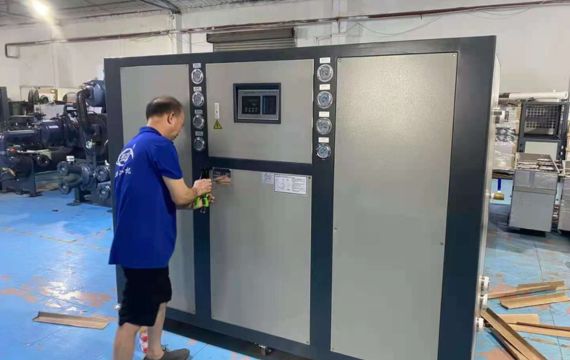
Chillers are indispensable temperature control equipment in industrial production and commercial applications. Their performance and efficiency are primarily dependent on the refrigerant used. The appropriate refrigerant is crucial for the chiller’s cooling effect and energy efficiency, safety, and environmental impact. This article will explore the key factors to consider when choosing a refrigerant for chillers.
What is the role of the refrigerant in a chiller?
Chillers rely heavily on refrigerants. They employ refrigeration to produce the cooling effect by soaking up and giving out heat. Specifically, the evaporator absorbs heat from the medium (like water or air), thus chilling it, whereas the compressor compresses the evaporated fluid, causing its temperature and pressure to rise again; then the condenser discharges heat, reversing into a liquid form; finally,, expansion valve decreases refrigerator pressure and returns it to evaporation vessel where hotter is absorbed before repeating cool cycle. Consequently, the industrial chiller’s cooling efficiency, operational stability, and environmental impact depend on the refrigerant choices.
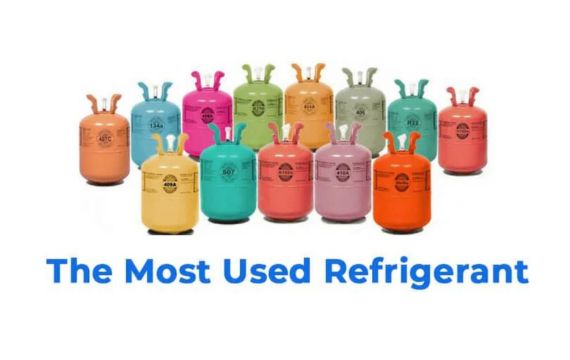
What are some of the Most Common Types of Refrigerants?
R22
R22 is an air conditioner refrigerant extensively used in cold rooms and other cooling apparatus. It gives reliable and consistent cooling benefits. Nevertheless, it is now being phased out because it depletes the ozone layer, which has led to its ban in areas like Europe and America.
R134a
Another commonly used eco-friendly refrigerator type is R134a, which is frequently applied in vehicle ACs and commercial fridges, among other applications. It offers better cooling efficiency with lower toxicity and environmental effects than R22 and can substitute for older fluids such as R12 and R22.
R410a
R410a is a novel kind of green refrigerant widely utilized in residential air conditioners, commercial freezers, and chillers, among other uses. It has excellent cooling capacity while being almost non-toxic or environmentally aggressive. However, high-pressure fluorine oil must be employed during operation.
R407c
Air conditioning units and chillers use another new environmentally friendly refrigerant called R407c. This one provides efficient cooling services along with less harm to the environment. However, its effectiveness may decline when employed in freezing machines with reduced condensation temperatures.
What are the critical considerations for refrigerant selection?
Application Scenarios
- Food Processing Industry: Prefers non-toxic and harmless natural refrigerants.
- Large Commercial Air Conditioning: You may opt for more efficient synthetic refrigerants.
Temperature Range
- Medium to High Temperature Applications: Suitable for using R134a.
- Low Temperature Applications: Suitable for using R404A.
System Efficiency
- Selection: Choose refrigerants with the best thermodynamic performance under specific working conditions.
- Goal: Improve the system’s coefficient of performance (COP).
Safety
- Considerations: Evaluate the toxicity and flammability of the refrigerant.
- Priority: In enclosed spaces or areas with high personnel density, prioritize refrigerants with higher safety.
Environmental Impact
- Selection: Choose refrigerants with zero ozone depletion potential (ODP).
- Selection: Choose refrigerants with low global warming potential (GWP).
- Goal: Comply with increasingly stringent environmental regulations.
Economy
- Considerations: Evaluate the cost of refrigerants.
- Assessment: Assess the availability of refrigerants.
- Calculation: Calculate potential system modification costs.
Regulatory Compliance
- Ensure Compliance: Ensure compliance with local environmental regulations.
- Adherence: Follow international environmental regulations, such as:
- The Montreal Protocol
- The Kigali Amendment
What is the market trend for refrigerants?
Transition to Low GWP Refrigerants
Globally, there is a gradual phase-out of high GWP HFC refrigerants in favor of HFOs or natural refrigerants.
Expanded Use of Natural Refrigerants
Natural refrigerants such as ammonia, CO2, and hydrocarbons are receiving increasing attention, mainly due to their good environmental performance.
Development of Mixed Refrigerants
By mixing different refrigerants, the goal is to balance performance, safety, and environmental protection.
System Optimization
Combine refrigerant selection with system design to improve energy efficiency by optimizing the overall system.
Before deciding on the refrigerant for a chiller, many things need to be considered since this is tedious and critical. As environmental awareness rises and modern technology evolves, refrigerant choice has become more environmentally friendly, efficient, and safe. Thus, it is necessary to consider performance requirements, safety standards, economic factors, and environmental concerns when choosing the appropriate refrigerant for your application to identify an optimal solution unique to specific applications. Additionally, understanding industry dynamics and environmental regulations related to refrigerants will help prepare for future replacements that allow chillers to be efficient over time.


