
Various mixers and blenders are essential for molding machines in the plastics industry. When customers inquire about these units, they often use the general term “Mixture & Blending Unit for Extruder Machine or injection or other molding machines” as they may be uncertain about the specific equipment they need. Here is a comprehensive overview of the common types and their applications:
1. Plastic Color Mixer and Color Master Batch Machine(volumetric doser)
Working Principles of two
Plastic Color Mixer: Different colored plastic pellets are fed into a mixing chamber, where color adjustment is achieved through physical mixing. Different colored plastic pellets need to be prepared and added to the mixing chamber according to specific proportions for blending.
Volumetric Doser: Colors and additives are pre-mixed to create masterbatches combined with plastic pellets. Color masterbatch machines offer more flexibility, allowing for specific colors and additives to be provided for different plastic pellets according to requirements.
Application Scenarios
Color Mixing Machine
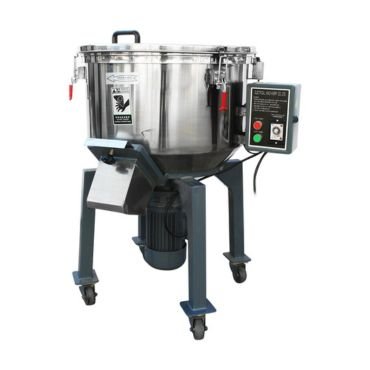
Suitable Applications: Mass production of single-color plastic products, such as plastic buckets and chairs.
Advantages: Simple operation, flexible color adjustment
Disadvantages: Lower color precision, potentially larger color variations
Volumetric Doser
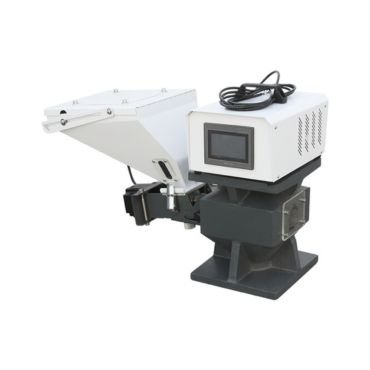
Suitable Applications: Production of multi-colored plastic products, such as plastic stationery and boxes.
Advantages: High color precision with minimal deviation; ability to add anti-aging agents, antioxidants, and other performance-enhancing additives
-Disadvantages: Complex process, suitable for scenarios requiring precise specifications
Conclusion
Color mixing machines are suitable for producing large quantities of single-color plastic products, offering simple operation but moderate precision. Color masterbatch machines are better suited for making products in multiple colors, providing Ⅱhigher color precision and the ability to incorporate functional additives. Choosing the appropriate equipment based on production requirements can significantly improve efficiency and product quality.
2. Vertical Silo Mixer
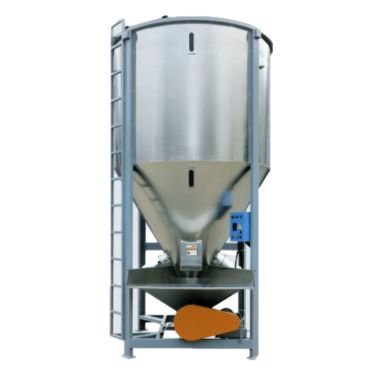
Vertical silo mixers are industrial-scale equipment designed for high-capacity mixing applications with the following characteristics:
Key Features:
- Designed for large-scale operations with capacities ranging from 0.5 to 20+ tons
- Available with integrated heating and drying functions
- Also known as a vertical mixer dryer machine or mixing silo machine
Applications:
- Plastic Industry: Blending of granules, additives, and masterbatches
- Food Processing: Large-scale mixing of powders and granules
- Animal Feed:** Industrial feed preparation and mixing
- Chemical Industry:** Bulk powder and granule blending operations
3. Differences Between volumetric feeder and Gravimetric Blender
Volumetric Feeder:
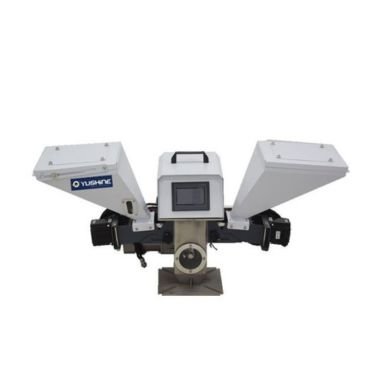
- A metering-type color master batch machine is used for injection molding, extrusion, and blow molding processes. Key features include:
- Automatically blends one main material with 1-2 color masterbatches or additives
- Features PLC color touchscreen control for intuitive operation
- Screw diameters available in 12, 14, 16, 20, and 25mm specifications
- Output capacity ranges from 0.04 to 32 kg/hour
- Available in dual-color configurations for flexible color mixing needs
Gravimetric Blender:
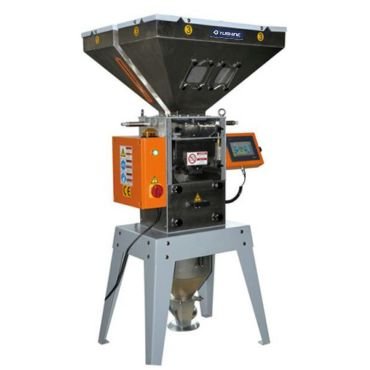
- A gravimetric blender uses internal electronic weighing systems for precise proportion mixing. Key features include:
- Automatic weighing of various materials, color masterbatches, and additives
- Built-in auto-correction functionality
- Can handle up to four components standard (customizable to six or more)
- Uses side-pull metering valves and screw metering valves for materials below 5% ratio
Key Differences:
Application: Gravimetric blenders are suited for complex formulations and large-scale production (processing tens of kilos to tons per hour), while color master batch machines focus on precise color addition for simpler formulations (processing a few kilos to hundreds of kilos per hour)
Working Principle: Gravimetric blenders use loss-in-weight measurement systems, while color master batch machines typically use screw-type metering feeders
Production Scale: Gravimetric blenders are ideal for large-scale, complex formula production, while color master batch machines are better suited for production lines requiring high color precision
