
1、Air Cooled Chiller
The air-cooled chiller adopts a single-stage vapor compression circuit with several protective functions, including compressor overload, pump overload, phase reversal and phase loss warning, anti-freezing, high and low pressure, etc., with stable performance and long service life. It can achieve fast cooling and stable temperature control according to customer requirements. According to the principle of heat exchange, it is an indispensable piece of equipment for modern industrial cooling.
The features of the chiller equipment are as follows:
- Cooling temperature range: 7~35°C;
- Stainless steel insulated water tank;
- Anti-freezing protection device;
- Utilizes R22 refrigerant, can also switch to R407C environmentally friendly refrigerant for effective cooling;
- Refrigeration circuit controlled by high and low-pressure switches;
- Overload protection for both the compressor and pump;
- Equipped with an original high-precision temperature control gauge;
- Easy operation, simple structure, and easy maintenance;
- Standard configuration includes a low-pressure pump, with options for medium or high-pressure pumps;
- Optional water tank level gauge;
- Uses imported compressors;
- Air-cooled models use a finned condenser, which provides excellent heat transfer and fast heat dissipation and does not require cooling water.
2、Structural Features and Working Principle
An air-cooled chiller mainly consists of four parts: compressor, condenser, thermal expansion valve, and evaporator. It utilizes a single-stage vapor compression refrigeration system based on the working principle of achieving a cooling effect through the gas-liquid phase change of refrigerant, which absorbs and releases heat.
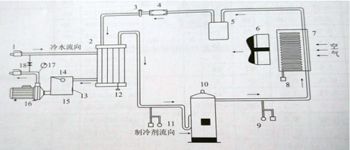
- Ball valve; 2. Evaporator; 3. Expansion valve; 4. Dry filter; 5. Liquid receiver; 6. Fan; 7. Condenser; 8. Pressure relief valve; 9. High-pressure controller; 10. Compressor; 11. Low-pressure controller; 12. Anti-freeze switch; 13. Temperature sensor; 14. Float switch; 15. Water tank; 16. Pump; 17. Pressure gauge; 18. Bypass valve
Upon starting, compressor 10 begins to work, compressing the refrigerant into high-pressure gaseous refrigerant. This refrigerant enters condenser 7 and undergoes heat exchange with the cooling water. It then flows through the expansion valve 3 and condenser 2, passing through these devices in sequence until arriving at compressor 10. At this point, one refrigeration cycle is complete.
The main component and its function are as follows:
1、Compressor
- Compresses and transports refrigerant vapor, creating low pressure at the evaporator and high pressure at the condenser. It is the heart of the entire system.
- The compressor is available in two types: scroll and piston.
- The power generally accounts for 25% to 30% of the chiller’s cooling capacity.
2、Condenser
- It is a heat-discharging device that releases the heat absorbed by the refrigerant in the evaporator and the heat generated by the compressor’s energy consumption to the cooling medium.
- It uses an air-cooled finned condenser.
3、Dryer Filter
- Removes impurities from the refrigerant and absorbs moisture during the refrigeration process to prevent ice blockages, especially at narrow points in the piping, such as the expansion valve outlet.
- The filter size is typically selected based on the diameter of the refrigerant piping.
- Positioned before the expansion valve to protect its integrity.
4、Expansion Valve
- The expansion valve reduces the pressure of the refrigerant through throttling and regulates the refrigerant flow entering the evaporator.
- It is installed before the evaporator.
5、Evaporator
- The evaporator is the device that outputs the cooling capacity using a horizontal shell and tube evaporator.
6、High and Low Pressure Controllers
- High and low-pressure controllers control the working pressures at the compressor’s suction and discharge ports.
- The high-pressure controller is set at 25 bar, and the low-pressure controller is set at 2 bar.
- Alarms are triggered when the compressor’s discharge pressure exceeds 25 bar, or the suction pressure falls below 2 bar.
7、Liquid Receiver
5、Application
The chiller is used with the mold and injection molding machine to improve production efficiency. The diagram below illustrates a chiller used with a mold and an injection molding machine.

To learn more about the chillers produced by our company, please visit the following link.:https://yushineplastics.com/industrial-chiller/


